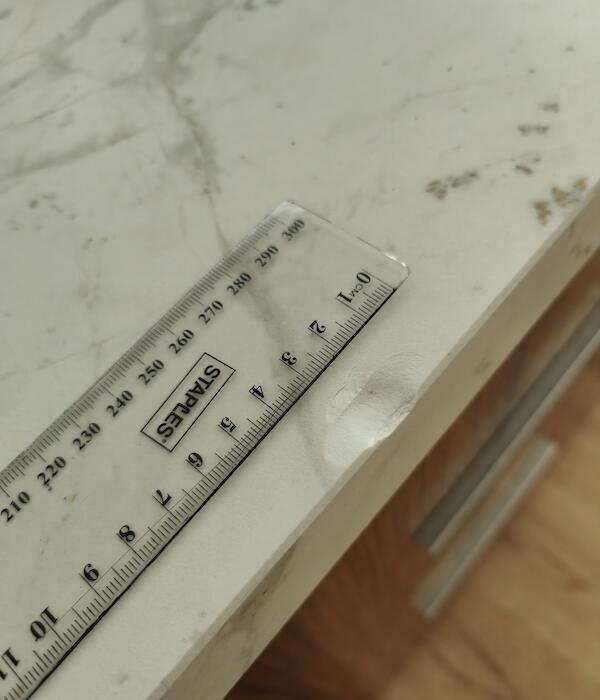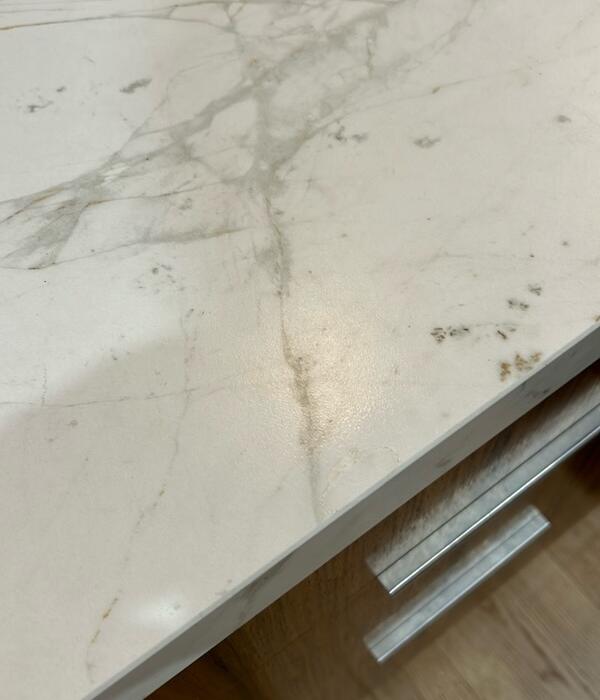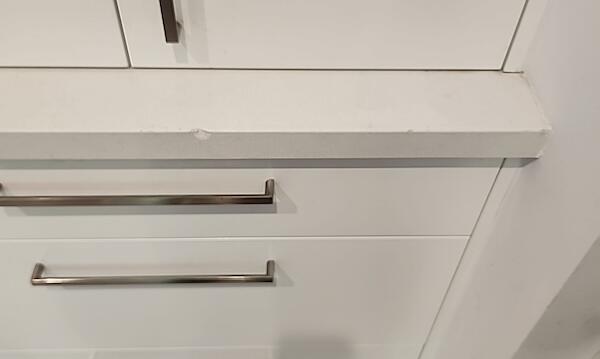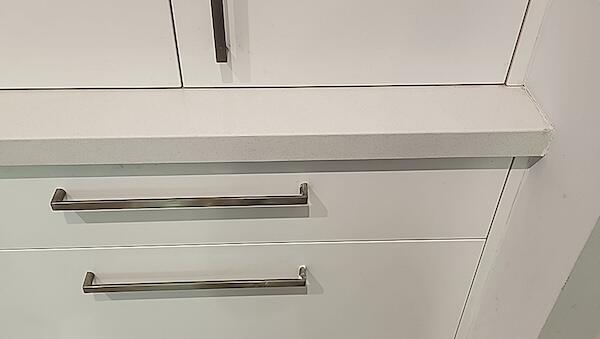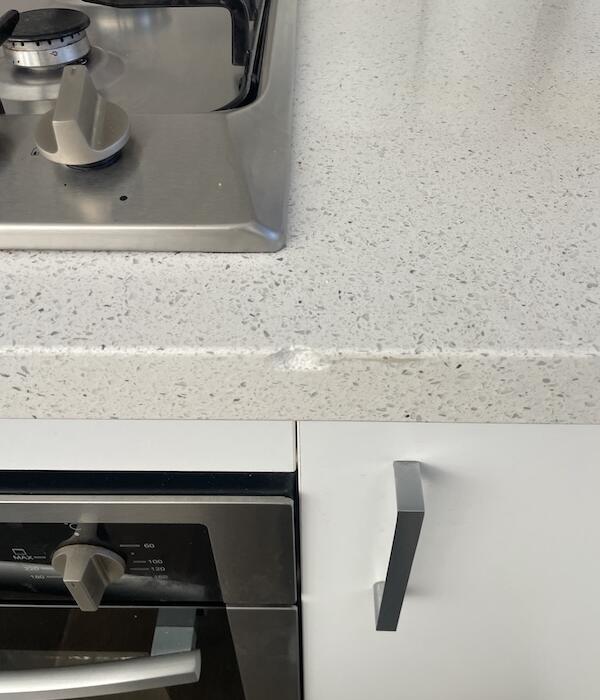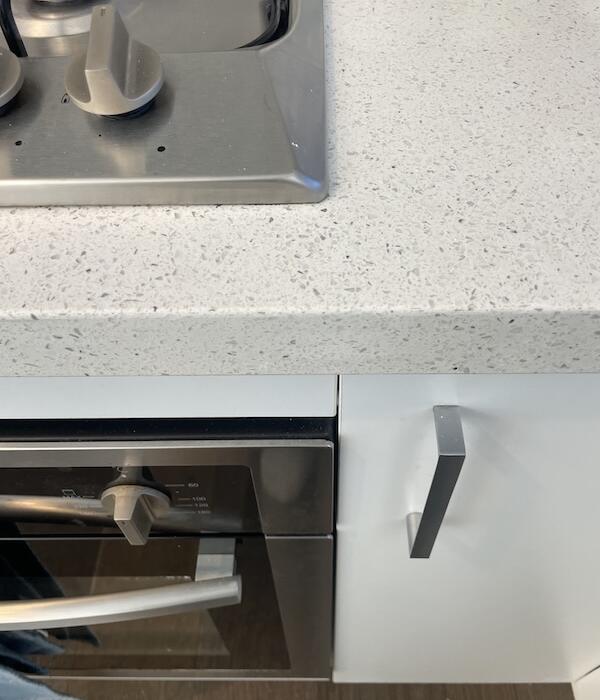
You spent weeks choosing your perfect kitchen benchtop. You compared slabs, weighed up finishes, agonised over edge profiles. You paid good money for it. And then — in a single, gut-dropping moment — something hit the corner and left a chip that now seems to be the only thing you can see every time you walk into your kitchen.
Welcome to one of the most common calls FIX ‘N’ CHIPS receives. And one of the most satisfying to resolve.
The Great Stone Benchtop Misconception
There’s a widespread belief that stone benchtops — whether engineered stone like Caesarstone or Smartstone, natural marble, granite, or porcelain — are essentially indestructible. They look it. They feel it. And to be fair, they’re extraordinarily durable under normal conditions. But durable isn’t the same as chip-proof. And the distinction matters.
Stone benchtops are hard — but hardness and brittleness often go together. The very rigidity that makes stone so resilient against scratches also makes it susceptible to fracturing under a sharp, concentrated impact. A cast iron pan dropped from the wrong height onto a corner. A heavy appliance — mixer, blender, coffee machine — slid carelessly across an edge. A cutting board that misses its mark. Any of these can produce a chip that feels completely disproportionate to the cause.
Corners and edges are particularly vulnerable. The engineered stone and marble slab is structurally supported across its full surface when it’s on the cabinet — but the overhang at the edge has nothing beneath it. Impact there concentrates force exactly where the material has least support. Which is why so many chips happen right at the front edge, commonly in front of the ktichen sink, the place you probably touch and brush past a hundred times a day.
Which Surfaces Chip Most Easily — and Why
Not all benchtop materials behave the same way under impact. Marble is beautiful and timelessly elegant, but it’s among the most chip-prone natural stones — its crystalline structure means fracture can travel further than you’d expect from a seemingly minor knock. Granite is generally more resilient, but certain colours and cuts are more prone to chipping along grain lines. Engineered stone — the Caesarstone, Smartstone and similar products that dominate modern Australian kitchens — varies significantly by brand and series, with higher quartz content generally offering better chip resistance.
Laminate benchtops chip differently: usually at the edge or corner where the laminate layer separates from the substrate, often as the result of water ingress, impact, or both. These repairs look quite different from stone repairs — but they’re equally achievable with the right approach.
Porcelain benchtops are increasingly popular, and are among the hardest surfaces available. They’re also among the most challenging to repair well, because the surface is fired at extremely high temperatures and achieving a colour and texture match requires genuine expertise.
That Heart-Stopping Moment — and What Comes After
The emotional arc of a benchtop chip is remarkably consistent. First: the sound, or the visual of something catching the corner. Then: the close inspection, hoping it’s superficial. Then: the quiet dread as you realise it’s not. And then, for most people, a period of living with it — averting your eyes slightly every time you make a coffee, noticing it when guests come over, Googling replacement costs and quietly wincing.
What many people don’t realise — until they find FIX ‘N’ CHIPS — is that living with the chip was never actually necessary. A professional chip repair can address most benchtop chips: filling the void with an appropriate specialist filler, colour-matching to the specific surface, adding back the detail, and finishing in a way that blends into the surrounding material. The goal isn’t to make it look like nothing ever happened — it’s to make it no longer the first thing you see.
What a Good Benchtop Chip Repair Actually Looks Like
The process starts before anyone arrives at your home. Send a photo — ideally with a coin or ruler for scale — and your local FIX ‘N’ CHIPS expert can assess the job and provide a quote. This means no call-out fee just to find out if repair is viable.
On the day, the repair involves cleaning and preparing the damaged area, selecting and applying the right specialist filler material for the specific surface, building up and shaping the repair, colour-matching with careful attention to the pattern and tone of your particular slab, and finishing and sealing the area. The whole process typically takes a couple of hours for most chips.
The result? Customers reach for their before photos to remember where the chip was.
“Andrew attended as scheduled to repair our kitchen bench. The repair was so perfect I can no longer find where the chip was.” — Marianne Corbett, FIX ‘N’ CHIPS customer
“Rob did an outstanding job fixing a large chip on my stone benchtop. His attention to detail was amazing and I was so happy with the result.” — Brent James, FIX ‘N’ CHIPS customer
“We recently had Matt repair a bench top for us, he did an amazing job, the chip is undetectable and it was great value. We are so happy with it.” – Tara, FIX ‘N’ CHIPS customer
“Our benchtop had several large chips and sharp damaged edges. I contacted Fix N Chips, and Jason did an outstanding job. His workmanship and professionalism were excellent, and the benchtop looks brand new again—just like it was before. Highly recommend his service. Great work, Jason!” – Jitender, FIX ‘N’ CHIPS customer
“Thankyou to Ahmed for his skillful work in repairing an unsightly chip on the corner of my caesarstone bench, he also kindly touched up a small one around my sink as well. His price to repair was very reasonable, he was prompt in communicating and a lovely person to deal with. I would recommend Ahmed at Fix’n’Chips to anyone on the Mornington Peninsula looking for chip repair work.” – J M, FIX ‘N’ CHIPS customer
Before You Call the Stone Mason
A benchtop replacement — even a partial one — is a major undertaking. It typically means removing the sink, disconnecting plumbing, dealing with the cabinetry underneath, and sourcing a slab that matches the rest of your kitchen. Even when that’s achievable, the cost is significant and the disruption considerable.
Before any of that becomes necessary, it’s worth asking whether repair is an option. In many cases, for most materials, with most chip sizes, it is. And the cost comparison — repair versus replace — is rarely even close.
If you’ve got a chip in your benchtop that’s been quietly ruining your kitchen for longer than it should have, get in touch, send a photo, and find out what your local FIX ‘N’ CHIPS chip repair expert can do. You might be surprised how quickly yesterday’s disaster becomes today’s solved problem.
Before & After Benchtop Chip Repair Photos